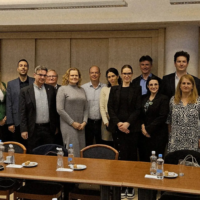
On November 13, 2024, the second EGTC workshop of 2024 took place in Budapest, financed by the Ministry of Foreign Affairs and Trade and with the professional support of CESCI. The aim of the event was to discuss cross-border cooperation and legal accessibility.
The professional program began with the opening speech of Gabriella Solymosi-Dobi, chief advisor to the Government of the Department of Regional and Border Development. The first speaker of the workshop was Kitti Dubniczki, director of CESCI, who reported on the progress of the #ACCESS project. The project aims to identify and resolve legal and administrative obstacles that hinder cross-border cooperation on the Slovak-Hungarian border section. In her presentation, the director highlighted the significant role that EGTCs could play in legal accessibility and encouraged the groupings to seek opportunities to engage in different areas of legal accessibility in line with their own development strategies.


The next speaker, Katalin Fekete, legal expert of CESCI, examined the issue of legal accessibility at the European level, primarily through the b-solutions initiative. In her presentation, she discussed in detail the important role that EGTCs play across Europe in reporting b-solutions cases, and pointed out the active role that Hungarian EGTCs play. During the presentation, she also drew attention to the fact that the role of EGTCs in accessibility is implemented at different levels, from strategic decisions to sector-level solutions.
Then, Gabriella Solymosi-Dobi and Norbert Jankai, legal expert of CESCI, gave a presentation on the experiences of legality supervision and audits. The chief advisor presented the basic rules for the legality control of EGTCs, which are based on Section 14 of Act LXXV of 2014 on European Groupings of Territorial Cooperation. In the presentation, she discussed the supervisory powers of the Ministry of Foreign Affairs and Trade and the strictest sanctions, which may result in the termination of EGTCs in the event of a violation. Summing up the results of the 2024 inspections, the speaker also touched on the issues of general legal compliance and actual operation. In her presentation, she addressed the supervisory powers of the Ministry of Foreign Affairs and Trade. The speaker highlighted that during the inspections, the examination is carried out according to two aspects: in addition to general legal compliance, the actual operation is also examined. She also indicated that in the event of a serious violation, the strictest sanction is the termination of the EGTC concerned. At the end of her presentation, she summarised the results of the 2024 inspections and the general proposals formulated based on them.


Norbert Jankai drew attention to the shortcomings encountered during the legality checks. Among other things, he mentioned that in many cases, instead of the required minutes, the EGTCs only make notes of their meetings. In addition, in many cases, the proper management of signature rights and commitment rights, as well as the shortcomings of the new member recruitment procedures, cause problems. In his comment, he suggested that a self-check list could be prepared for each EGTC, with which they could review their own operations.
After the presentations, the EGTCs had the opportunity to ask questions. Among the questions raised was how EGTCs can use a customer portal, for example in the case of invoicing through the system of the National Tax and Customs Administration. Based on the answers, accountants can easily solve this, since the use of the customer portal is tied to a specific employee of the given organisation, and their operation is similar to that of economic organisations. The workshop was closed by Zsolt Antoni, Head of the Regional and Border Development Department, who briefly discussed the expected support schemes for 2025. The call for applications for the annual operational and project financing support for EGTCs will be published on https://egtc.kormany.hu/hirek.


Program
Wednesday, November 13, 2024
- 10:00 – 10:10 Welcome speech – Péter Kiss-Parciu, Deputy State Secretary, Ministry of Foreign Affairs and Trade
- 10:10 – 10:25 Organisational and operational practices of EGTCs, experiences of legality checks – Dr. Gabriella Solymosi-Dobi, Senior Government Advisor, Ministry of Foreign Affairs and Trade, Dr. Norbert Jankai, Legal Expert, CESCI
- 10:25 – 10:40 #ACCESS project – results of the obstacle assessment process, identified obstacle types, lessons for other border sections – Kitti Dubniczki, Director, CESCI
- 10:40 – 11:00 b-solutions cases and European EGTCs, legal accessibility in the border region – Dr. Katalin Fekete Legal Expert, CESCI
- Questions, Answers
- 11:00 – 12:30 Roundtable, consultation with the Ministry staff
- 12:30 Sandwich lunch
Continue
to the summary
page of the EGTC-
workshops
Previous
EGTC-workshops


Honlapunk a Külgazdasági és Külügyminisztérium támogatásával készült.


