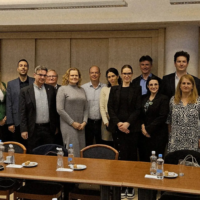
On 9 April 2025, the first EGTC workshop of 2025 took place in Budapest, financed by the Ministry of Foreign Affairs and Trade and with professional support from CESCI, focusing on direct EU funding opportunities and the coordination of EGTC development plans.
In the opening presentation of the event, Viktória Lilla Pató (MFOI: Hungarian Development Promotion Office Nonprofit Ltd.) presented the direct EU funding opportunities for EGTCs. She emphasised that although almost everyone is familiar with the operational programmes, far fewer people are aware of the direct EU funds available, even though these programmes offer significant resources (around one third of the total EU budget). There are currently 42 programmes with direct EU funding, and their share of the total EU budget is growing. The MFOI representative emphasised that the involvement of organisations in these calls for proposals requires structured and strategic thinking and careful partnership building. She considered it important to have not only financial needs but also innovative project ideas in the pipeline. She also shared more detailed information on some of the programmes (LIFE, European Urban Initiative (EUI), Erasmus+, CERV (Citizens, Equality, Rights and Values Programme), Digital Europe Programme, URBACT). She concluded her presentation by pointing out that the services offered by MFOI include consulting (project idea development, recommendation of consortia and platform organisations), policy advocacy, pro bono training and the development of e-learning materials. Although they do not write applications, they support the process from idea generation to application submission.


In the second presentation of the workshop, Mónika Simon (CESCI: Central European Service for Cross-Border Initiatives) provided information on the upcoming Interreg calls for proposals (2021-2027). Among the interregional programmes, she drew particular attention to the current URBACT call (Transfer Networks, open until 30 June 2025), which aims to support the transfer of good practices. With the support of the programme, applicants can adopt and implement practices that have been awarded the URBACT Good Practice label.
This was followed by a discussion on the development plans of the EGTCs, moderated by Mátyás Jaschitz (CESCI). The representatives of the EGTCs reported on their current projects and future plans.


In the operational section of the workshop, Dr. Gabriella Solymosi-Dobi (Ministry of Foreign Affairs and Trade) spoke about current issues affecting EGTCs. She introduced the new staff member of the Department of Regional and Cross-Border Development and presented the amount of operating support allocated to EGTCs for 2025. Her presentation was supplemented by Viktória Rakonczai on financial accounting issues, while Kitti Dubniczki (CESCI) presented a list of questions to assist EGTCs in their self-assessment in relation to experiences with legality audits.


Programme
9 April 2025
- 09:45 Welcome speech – Péter Kiss-Parciu, Deputy State Secretary, Deputy State Secretariat for Regional and Cross-Border Development, Ministry of Foreign Affairs and Trade
- 10:00 Viktória Lilla Pató, Senior Expert, Hungarian Development Promotion Office: Overview of directly accessible Brussels resources relevant to EGTCs
- 10:30 Mónika Simon, Project Manager, Central European Service for Cross-Border Initiatives: Overview of the still available Interreg resources relevant to EGTCs
- 10:45 Mátyás Jaschitz, Director, Central European Support Service for Cross-Border Initiatives: Moderated workshop discussion on the current development and application plans of the EGTCs
- 11:30 Coffee break
- 11:45 Dr. Gabriella Solymosi-Dobi Head of Department, Regional and Cross-Border Development Department, Ministry of Foreign Affairs and Trade: Ministry updates, EGTC management, pitfalls of support contracts, operating subsidies in 2025, new developments in legality supervision (self-assessment checklist)
- 12:00 Kitti Dubniczki, Director, Central European Service for Cross-Border Initiatives: Presentation of the guide for self-monitoring the proper functioning of EGTCs (verification of the implementation of content elements based on the applicable Convention, Statutes and regulations) Preliminary discussion of the venue and topics for the next workshop
- 12:15 Roundtable discussion, questions and answers
- 13:15 Sandwich lunch
Previous
EGTC-workshops


Honlapunk a Külgazdasági és Külügyminisztérium támogatásával készült.


