“Do not look at European space […] as if it were covered seamlessly by state territories.” – Closing conference of the BorderLabs CE project
BorderLabs + Knowledge sharing + Policy-making | 2026. June 22.
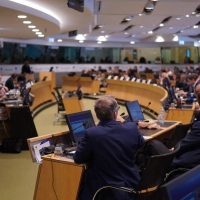
The partners of the BorderLabs CE project held the closing conference in Brussels on 10 June 2026, as a side event of the European Cross-Border Platform’s annual meeting. The conference attracted a broad audience of nearly 100 participants representing EU and national institutions, regions, cross-border initiatives, local authorities, practitioners and academia.
BorderLabs CE is a transnational project co-financed by the Interreg Central Europe programme, aiming to test and disseminate solutions targeting the barrier effects of administrative borders in Central Europe and, through these, facilitating stronger integration within the region and the EU. The partners (the Saxon State Ministry of Infrastructure and Regional Development, Institute for Territorial Development of the Lower Silesian Voivodeship, Euroregion Nisa, City of Frankfurt (Oder), EGTCs GO, Ister-Granum and Novum, the State Government of Upper Austria and CESCI) endeavoured to looking beyond the nation-state logic, as Professor Andreas Faludi, doyen of European spatial planning encouraged them in his video message (see the quotation in the title) displayed at the beginning of the closing conference.
As Martin Hutter, Deputy Head of the Managing Authority of the programme, highlighted, the programme region is cross-cut by 15 state borders, and many further boundaries hamper the development of functional links. Mr Oliver Schenk, member of the European Parliament, added the challenge of trust building to the picture, while Mr Pavel Branda, chair of the European Cross-Border Platform, outlined the mixture of local real-life experiences and the European perspective provided by BorderLabs CE.
The project targeted the administrative borders through three pillars of action:
- integrated cross-border strategic planning,
- cross-border participatory governance and
- the management of legal obstacles.
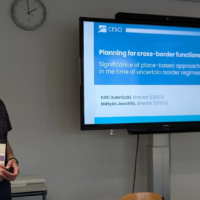
The three main panels of the closing conference addressed these topics. The first panel, moderated by Martin Reents (Infrastruktur und Umwelt), included testimonies related to cross-border planning. Maciej Zathey (IRT Lower Silesia) explained the difficulties they met when plotting the so-called triple-map, including the development ideas of the tri-border area of Saxony, Czechia and Poland. Kitti Dubniczki (CESCI) approached the question from the foreseen EU enlargement, which will require giving answers to the new spatial challenges. Sabine Zillmer (Spatial Foresight) differentiated between vision making, which does not need to be realistic, and strategic planning, which, on the contrary, must be. She also highlighted the dichotomy standing between the stronger and stronger national thinking and the understanding of the benefits of cross-border ties. Wiktor Szydarowski (ESPON EGTC) told the story of the Territorial Futures Forum initiative targeting a new spatial vision for Europe. The new concept will focus on every citizen’s life instead of growth and cohesion.


The second panel, moderated by Melinda Istenes-Benczi (CESCI), discussed different forms of participation in a cross-border context. Estelle Evrard (University of Luxembourg) brought the example of the so-called Biergerkomitee involving 30 selected citizens in the development process of the new spatial strategy of Luxembourg, and pointed out the significance of the dialogue in revising our own way of thinking. Sören Bollmann (City of Frankfurt / Oder) listed several participatory solutions adapted by the double-cities of Frankfurt and Słubice, such as the citizens’ forum supporting the design of the joint action plan of the two municipalities, the citizens’ picnic, the local development council, the Frankfurt- Słubice think-tank, and the Citizens’ Council, which is planned to be established as the next step. Dirk Peters, advisor of the Common Ground program of the Robert Bosch Foundation, drew attention to societal groups whose voices are hardly taken into account. As they sometimes miss even citizenship, it is better to speak about residents’ participation. Based on the lessons learnt from the program, he also mentioned several difficulties (e.g. language barriers, including the use of a simple language; cultural differences; differences in competences, etc.). Anne Thevenet (Euro-Institut of Kehl) delivered a compilation of practical recommendations on how to involve the target groups and ensure a neutral approach, facilitating seamless discussion.


The third panel addressed cross-border legal and administrative obstacles under the moderation of Gyula Ocskay (CESCI). As Micaela Passon (EGTC GO) stated, the management of legal obstacles has been forming part of their everyday work since the establishment of the grouping, as “once you solve a problem, another comes up”. The EGTC ambitions to become a cross-border coordination point along the BRIDGEforEU Regulation. Caitriona Mullan (AEBR) justified the significance of obstacle management by stating that every challenge identified by Mario Draghi in his report requires cross-border collaboration. The b-solutions initiative managed by the AEBR facilitates the elimination of obstacles hindering this collaboration. Katja Rosner (State Government of Upper Austria) compared the Austrian-Bavarian and the Austrian-Czech borders according to the types of barriers and the attitude of the institutions, informing that there are no one-size-fits-all solutions. Péter Nagy (Ister-Granum EGTC) summarised the difficulties concerning the development of an integrated cross-border system and trade mark of local producers. He repeated what other speakers also highlighted: cross-border cooperation needs patience.
Besides discussing the three main topics of the project, the closing conference also served to present the major outcome, namely, the Charter for participatory cross-border governance in Central Europe. Martin Reents contextualised the document, referring to the fragmented spatial structure of the region and the expected new enlargement, which will valorise the Central European area. He also presented how the activities of the project contributed to the charter. Gyula Ocskay invited the participants to comment on the document and to the workshop to be organised in October in Budapest, where the platform of the Central European planners and its online tool will be launched. This also means that the closing conference should not be considered as the last momentum of the project, and the project itself should be seen as the beginning of a process designed to result in a new spatial vision for Central Europe.


Honlapunk a Külgazdasági és Külügyminisztérium támogatásával készült.