Opening Conference of the Bridge2EastCE Project
Project development | 2026. April 07.
The Research Institute for National Strategy hosted the opening conference of the “Bridge2EastCE – Bridge to the East” project in Budapest, implemented with the support of the Interreg CENTRAL EUROPE Programme. CESCI was also represented at the event.
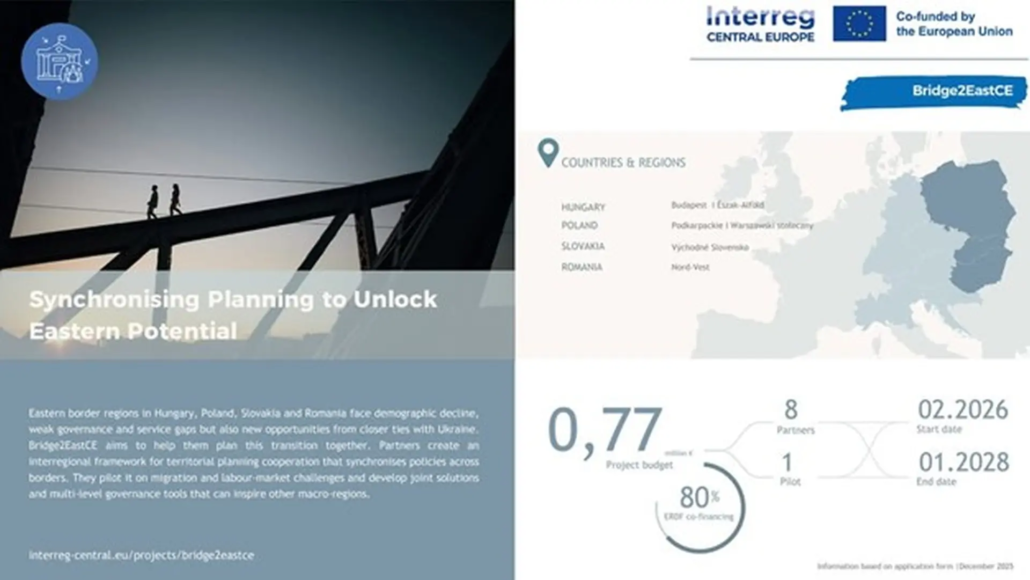
At the kick-off event held on 24 March 2026, the lead partner, the Research Institute for National Strategy, together with the project partners, presented the project and its structure. From the perspective of territorial planning, the initiative focuses on the analysis of European Union regions bordering Ukraine. The central question of the analysis carried out within the project is how the Russian-Ukrainian war has affected these border regions. The project seeks to strengthen the connecting role of this peripheral area through the implementation of coordinated development planning. The cooperation creates opportunities to reinforce professional collaboration, promote knowledge-sharing, and explore development potential. Running from 2026 to 2028, the project has a broad partnership involving 11 organisations from 5 countries. Regional partners contribute to the project’s success by presenting their local context and sharing their experience; knowledge partners provide professional support so that solutions can be developed on a scientific basis; while associated partners play a key role in implementation.
In the first part of the event, participants were welcomed by Jenő Szász, President of the Research Institute for National Strategy; Viktorija Dobravec, Programme Officer at the Joint Secretariat of the Interreg CENTRAL EUROPE Programme; and Endre Baracsi, Vice-President of the General Assembly of Szabolcs-Szatmár-Bereg County Council.
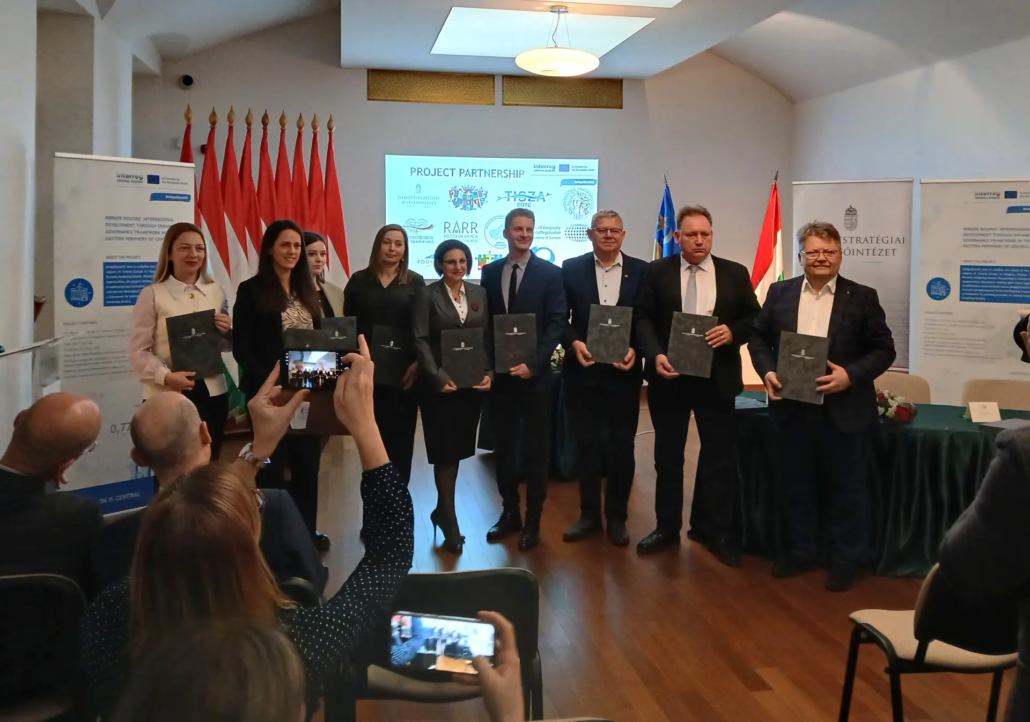
The first presentation of the conference was delivered by Peter Kónya, Rector of the University of Prešov, and focused on the socio-economic impacts of wars from a Central European perspective. In his presentation, he highlighted the bridge role of the East-Central European region and the unique identity it has developed over the course of history. His lecture was followed by the signing of the project partnership agreement.
The conference continued with a presentation by Norbert Pál, Government Commissioner for Persons Fleeing the Russian-Ukrainian War to Hungary, who outlined the circumstances of the refugee crisis caused by the war and its impact on the Hungarian labour market. In his presentation, he addressed both immediate and long-term interventions, including the organisation of charity actions, the distribution of aid packages, and the issuing of solidarity train tickets. Longer-term measures were needed to ensure access to healthcare, the labour market, and the education system. Thanks to these initiatives, the labour-market integration of Ukrainian refugees has been successful, and three Ukrainian-language educational sites have also been established in Hungary.
Gábor Mayer, Government Commissioner Responsible for the Complex Development of the Northwest Hungarian Economic Development Zone, gave a brief overview of the current state and prospects of territorial development in Hungary. He argued that the social and economic challenges resulting from suburbanisation and the urban-rural divide make it necessary to rethink cities’ functional catchment areas. Since the current functional urban areas cover only certain parts of the country, he proposed the use of a new territorial development methodology that would provide a more comprehensive picture of the areas of influence of settlements with central functions. This methodology also takes into account access to public services and daily commuting patterns.
This section of the conference concluded with a planning-oriented presentation of the Bridge2EastCE project by Márton Péti, Vice-President of the Research Institute for National Strategy. In his remarks, he drew attention to the specific characteristics of the EU’s eastern border region and the unique economic processes taking place there. This area, long characterised by economic and social challenges, has gained strategic significance in recent years, with cities such as Lublin, Rzeszów, and Košice also emerging as important economic centres. These regions serve as a kind of gateway between the European Union and Ukraine, from which local labour markets also benefit. As a result of the war, western Ukraine has become a kind of logistics hub, and a large share of the eastern labour force and businesses has relocated there. These spatial processes make it necessary to rethink territorial planning in the border region, which is one of the main objectives of the Bridge2EastCE project. Among other activities, the project will establish an Interregional Territorial Planning Cooperation (ITPC) framework, which will also be tested and finalised. In addition, the preparation of a background study is included among the project activities.
The event concluded with brief introductions by the project partners.
Honlapunk a Külgazdasági és Külügyminisztérium támogatásával készült.